Tuesday, June 26, 2012

VJD System - Alternative to the Duckworth-Lewis Method


Although the Duckworth-Lewis method is widely used in international and first class level there are many criticisms about this method.One of the main criticism about the DL method is that it gives a higher weight to number of wickets remaining rather than number of overs left. As an example DL par score jumped from 117 to 140 at the end of 20 overs when West Indies lose there 4th wicket in the 20th over at the recently concluded first ODI match between England and West Indies.WI were 1 run ahead before the wicket and suddenly 23 runs behind the target after the wicket.Thus it is very important to a chasing side, not to lose wickets rather than maintaining the required run rate.


Another problem with the DL method is it's inability to handle the power play overs.There is no way to account for the number of power play overs left and number of power play overs played. Also since it uses a G50 score concept where the average score was considered as 250 for an ODI match ,the target scores obtained by DL method was not very justifiable for very low scores and and for very high scores. Thus the effectiveness of the Duckworth-Lewis method is limited to a range of scores distributed around 250. Although this error was corrected for a certain extent in the professional edition still the Duckworth-Lewis method is not that accurate in lower scores and higher scores.
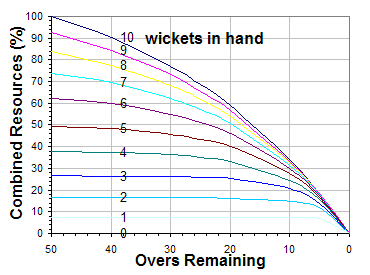
Duckworth-Lewis Curves


Also when multiple interruptions happens the targets given by the Duckworth-Lewis have many anomalies.  The target given by the Duckworth-Lewis method when the interruption happens during an innings break clearly favors the chasing side if the first innings score is high.This is because they have all the ten wickets in hand at the start and the number of overs are reduced. Due to this fact these days captains choose to field when they win the toss if rain is expected during the match.


Also Duckworth-Lewis method was originally designed for ODI matches. Thus when this was used in T20 matches it gives inefficient and unfair results. This may be because the lack of data to construct the resource curves for T20matches. In-fact the unsuitability of the Duckworth-Lewis method in T20 is the main criticism against it.

V. Jayadevan
Thus the need of a new system to be used in rain affected matches have been raised. The main competitor that has challenged the Duckworth-Lewis method is V. Jayadevan method which is used in Indian domestic matches. This is widely known as VJD method.


The designer of this method V. Jayadevan is currently working as an Engineer, Irrigation Department, Kerala. He has spent fifteen years to develop VJD system which is used for calculating revised target due to interruptions in ODI & T20 cricket matches, as an alternative to the existing D/L system.


Previous posts on Duckworth-Lewis method.

  1. Duckworth-Lewis Method (part 1)
  2. Duckworth-Lewis Method (part 2)
  3. Duckworth-Lewis Method (part 3)

Tuesday, June 5, 2012

Transit of Venus

The last Venus transit for this century will be visible to Sri Lanka Tomorrow (June 6th). This will be a great opportunity to us.Following details may help to observe the transit safely and correctly.


Viewing Safely


It is very important to use the safety procedures while observing the transit.Inappropriate viewing methods may result in blindness and other eye problems. Following link contains some safe viewing methods.


Useful Links


Saturday, May 26, 2012

The Hawk Eye Technology


Technology has become an integral part of our lives. The use of technology in sports have also been increased. At first it was about broadcasting events worlwide.  But in the modern times technology is used to increase the fare-play in sports. Cricket has been one of the sports that uses technology extensively.  The first instance of using technology in cricket may be the third umpire concept which was first used in a test match in 1992. Although it was just a simple TV replay it helps a lot to take correct decisions on run outs and stumping and sometimes the legality of catches and to decide about boundaries.
But within the last few years more sophisticated technologies have been emerged and they are now been used in the game of cricket. One such technology is the hawk eye technology which is used in UDRS (Umpire Decision Review System).

History


Dr.Paul Hawkins
Hawk-Eye is a ball tracking system which is also used in other sports such as tennis. This technology is controlled by the Hawk-Eye Innovations Ltd which is a part of Sony Europe. Initially this was used as a broadcasting tool in cricket LBW decisions and now has become an important part in the decision making process in cricket matches.
The initial research for the Hawk-Eye technology began in 1999 by Dr.Paul Hawkins at Roke Manor Research Ltd. In the year 2001 channel 4 used this technology in broadcasting the Ashes series. In February 2002 this technology was first used in tennis broadcasting. In 2005 Hawk-Eye was permitted to be used as an officiating aid in tennis. This is mainly used to detect the line-calling decisions. In 2007 MCC world cricket committee announces that the Hawk-Eye will be used in the Decision Review System used in cricket.   In 2011 Hawk-Eye was used in a Cricket World Cup for the first time in history. Also there are plans to use Hawk-Eye in Soccer. This is still at the testing stages of FIFA and if the results are successful, this will be used in 2014 world cup.

Technology


Camera Placement in Tennis
The Hawk-Eye uses six high speed vision processing cameras positioned at different places in the ground along with two broadcast cameras to calculate the trajectory of the ball. Although there are 8 cameras available only 5 cameras are used depending on the side of the wicket that’s been used. In tennis there are around 10 cameras to track the ball. These cameras obtain a 3D visualization of the path of the ball after it’s been bowled. There will be two trajectories for each ball one for releasing the ball by the bowler up to pitching and another one for pitching the ball up to hitting the batsmen. Using this technology the speed of the ball, the swing of the ball from the bowler’s hand to the pitching point, the pitching point, the bounce of the ball, the spin or deviation of the ball can be obtained. Based on the second trajectory the expected path of the ball will be calculated and used to determine whether it will hit the stumps. This is widely used to decide LBW decisions.


Controversies


Camera Placement in Cricket
When technology is used in a sport there will be three very important things to consider. First it should be accurate. Then it should be fast enough so that the momentum of the game is not lost due to technology and finally it should be economically and technically affordable to use in normal games.
Hawk-eye is financially feasible. It is a low cost solution which only needs several cameras and some computers to do the calculation. Since cameras will be always available in an international sporting event the installing cost is very low. Also the time taken to calculate the path of the ball is short but sometimes this may damage the momentum of the game. This is one reason that the number of challenges by the players against the normal decisions taken by umpires or referees is limited. In cricket this is two reviews per team in each inning. Also in tennis the player will get two incorrect challenges per and three challenges in a tie break.
But the problem with the Hawk-eye is its accuracy. Although in tennis they have proved that it has an accuracy of 3.6mm in line calling decisions Hawk-Eye has failed to obtain the trust among players, referees and the general public. Also there are few instances in cricket that the decision given by the hawk-eye system is different than what most of the people expected.


Monday, May 21, 2012

Words are all I have, to take your heart away - Bee Gees


Bee Gee legend Robin dies


Robin Hugh Gibb (22 December 1949 – 20 May 2012) was a British singer and songwriter. He is best known as a member of the Bee Gees, co-founded with his twin brother Maurice and older brother Barry. He had another younger brother, Andy Gibb, who was also a very popular solo singer.


Below is one of my favorite songs.This is a song by the Bee Gees, written by Barry, Robin and Maurice Gibb. Barry said in 1996 on the VH1 Storytellers television show that it was written for their manager Robert Stigwood.


Smile an everlasting smile, 
a smile can bring you near to me. 
Don't ever let me find you down, 
cause that would bring a tear to me. 


This world has lost its glory, 
let's start a brand new story now, my love. 
Right now, there'll be no other time 
and I can show you how, my love. 


Talk in everlasting words, 
and dedicate them all to me. 
And I will give you all my life, 
I'm here if you should call to me. 


You think that I don't even mean 
a single word I say. 
It's only words, 
and words are all I have, to take your heart away. 


Friday, March 30, 2012

Some Chuck Norris Facts- Explains Many Things

  • Chuck Norris' tears cure cancer. Too bad he has never cried. 
  • Chuck Norris has already been to Mars; that's why there are no signs of life there. 
  • The Great Wall of China was originally created to keep Chuck Norris out. It failed miserably. 
  • When Alexander Bell invented the telephone he had 3 missed calls from Chuck Norris 
  • Chuck Norris counted to infinity - twice. 
  • Chuck Norris wakes up his alarm clock 
  • Chuck Norris doesn't call the wrong number. You answer the wrong phone. 
  • There used to be a street named after Chuck Norris, but it was changed because nobody crosses Chuck Norris and lives. 
  • Some magicians can walk on water, Chuck Norris can swim through land. 
  • Chuck Norris remembers the future. 
  • Chuck Norris and Superman once fought each other on a bet. The loser had to start wearing his underwear on the outside of his pants. 
  • Chuck Norris will never have a heart attack. His heart isn't nearly foolish enough to attack him. 
  • Chuck Norris received his pilots license by just looking at an airplane. 
  • Chuck Norris does not hunt because the word hunting infers the probability of failure. Chuck Norris goes killing. 
  • Chuck Norris called 911 to order Chinese food and got it. 
  • Only Chuck Norris can dislike on Facebook 
  • Chuck Norris uses a sundial at night. 
  • When Chuck Norris looks at himself at a mirror, there is no reflection. There can only be one Chuck Norris. 
  • Contrary to popular belief, Chuck Norris cannot fly. He just jumps and chooses when to come down. 

Friday, February 10, 2012

So far they WON all matches,So will they LOSE the next ? ( The Gambler's Fallacy)

Well they won all the test matches against India. And so far all the matches of the CB series. They are not a very strong team as the previous Australian teams who controlled the world cricket arena for more than dozen years. But recently they have managed to win a fair amount of matches continuously.  Although Australia have the home advantage I think all the three teams have a somewhat fair chance of winning a match. The probability of an Australian win may be high but the probability of two consecutive wins will be low. And of course the probability of three continuous wins will be much lower. So Does this mean that Australia have a very high chance of loosing the next game ? or India have a high chance of winning the match on 12th ? or more importantly if Australia win on 12th Sri Lanka have very very high chance of winning the next match against Australia ?


This leads us to a very interesting fallacy in probability named as the Gambler's fallacy or Monte Carlo fallacy. So its time to think about this fallacy leaving cricket for a moment.

The Gambler's Fallacy

                 The basic idea of the gambler's fallacy is based on the perception we have that a result which we have obtained for a lengthy sequence will change in the next event. If we got 5 or more heads in a row while tossing an unbiased coin most of the time we will expect a tail in the next event. Not only we think but also we may incorrectly derive that the probability of a tail is much higher than 0.5 and reaching to 1. Lets check this using an example. Lets assume we have a fair coin so that the probability of a head or a tail equals 0.5. Lets consider the case where we get 5 consecutive heads. Then the probability will be 0.5^5=0.03125 which is a very rare event. So now consider a situation where we have already got 4 consecutive heads. So the big question is what is the probability of getting another head in the next tossing of the coin ? One may solve the problem in the following way.
Since the probability of getting 5 consecutive heads is 0.03125 the probability of not getting a head is 1-0.03125=0.96875. So the probabilities of getting a head and getting a tail is respectively 0.03125 and 0.96875. This reasoning highly favors a tail in the next tossing of the coin and this leads to the famous Gambler's Fallacy.
                            The problem of the above reasoning is that it does not take the independence of each tossing. It may be true that we had 4 consecutive heads so far. But it does not alter the probability of the next event. What has happened so far is simply the past and unlike in some real life scenarios they don't affect the future. There will be no demons or angels from the past events affecting the future when the events are simply independent.
                            So the probability of getting a head in the next tossing is still 0.5.  This confusion is the basic root of the gambler's fallacy. When a same result is observed for a large number of times people tend to think that the opposite will occur in the future. Based on that assumption they will bet on those results. This simple fallacy will lead to many interesting explanations of some events. Also there may be some instances where the gambler's fallacy may not be applied. As an example assumption of independence of events may not be totally correct. 
                             In the scenario at the beginning the events are not independent. There is a very slight dependence. Due to the consecutive wins they  may decide to give an opportunity to a new player or to rest some senior players. Then the Gambler's fallacy will not become a fallacy any more and the other two teams may increase their chance of winning. 

Saturday, December 24, 2011

Merry Christmas and a Happy New Year !

It's Christmas.Though now it has become a commercial event, there is something special in every Christmas for me. In the early years of my life it was about the Santa and the presents I received. But the time has passed and now entering the period of my life where I have to give presents to others rather than expecting .Now its the time you see scary Santas in shops trying to sell various items.It's the time where you cant travel in a road even in the off peak hours.It's the time you see discounts everywhere.Anyway beside all the changes still its a time to rejoice.It's a time to enjoy with the family and friends.

This carol "Mistletoe and Wine" is a popular single by Cliff Richard.Written by Jeremy Paul, Leslie Stewart and Keith Strachan, this was originally performed as part of the musical Scraps which was based on Hans Christian Andersen's fairytale at the Orange Tree Theatre, Richmond, London in 1976.

The child is a King, the Caroller sing,
The old is past, there's a new beginning.
Dreams of Santa, dreams of snow,
Fingers numb, faces aglow.

Christmas time, Mistletoe and Wine
Children singing Christian rhyme
With logs on the fire and gifts on the tree
A time to rejoice in the good that we see

A time for living, a time for believing
A time for trusting, not deceiving,
Love and laughter and joy ever after
Ours for the taking, just follow the master.

Christmas time, Mistletoe and Wine
Children singing Christian rhyme
With logs on the fire and gifts in the tree
A time to rejoice in the good that we see

Silent night, holy night

Its a time for giving, a time for getting,
A time for forgiving and for forgetting.
Christmas is love, Christmas is peace,
A time for hating and fighting to cease.

Christmas time, Mistletoe and Wine
Children singing Christian rhyme
With logs on the fire and gifts on the tree
A time to rejoice in the good that we see.

Christmas time, Mistletoe and Wine
Children singing Christian rhyme
With logs on the fire and gifts on the tree
A time to rejoice in the good that we see.

Merry Christmas  and a Happy New Year !