Tuesday, November 15, 2011

How Secured is Your Security Question ????


You may have seen different kinds of questions such as "What is your library card no ?" , "what is your mothers birth town ?", while registering for an online account.These questions are used in password recovery processes and additional sign in verifications. Normally we all care about our passwords and worry about the security of the password.

But do we really care about these security questions ? It seems most of us don't care much about these.Most of the time we give our real details as the answers to theses questions and simply forget about the security question.Even I was unaware of security questions selected for my email address until i decided to write this post.The most surprising thing is that I can't come up with the correct answer for those questions.I think this is common between most of us.We really DON'T CARE about those.
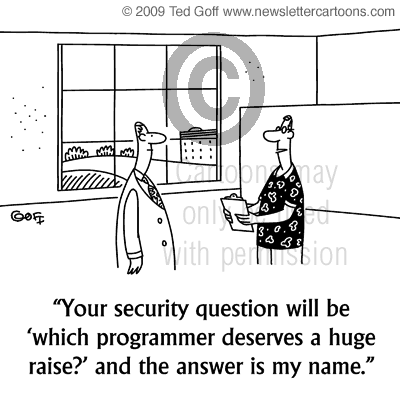

But in reality this is a great security risk.Even if you have a very good password that can not be guessed easily,you may be vulnerable to security threats.It is like locking the front door while leaving the backdoor open.The confidentiality of the answers for a security question will be far less than a password.If some one asks you a password you probably wont tell.But if some one asks you the birth town of your mother you may answer it.Also most of the details that are asked in security questions can be found publicly or can easily be guessed.That is what happened with the email account of Sarah Palin the vice president candidate during 2008 elections.

A good security question should have a answer which can be easily memorized, which is not publicly available and which does not change overtime. Further the possible number of answers for the question should be very large so that it can not be guessed. There are some websites which offers good security questions. But it is worth to note that the goodness of the question depends on the expected answer as well.


Thursday, November 3, 2011

Pigeon-Hole Principle

It's amazing how a very simple and obvious thing in life become a mathematical principle and helps to prove many complex results. Pigeon-Hole principle is one such concept. At first it seems as a very obvious fact and one may wonder whether it deserves such a place in mathematics. But this principle becomes very useful in many occasions to prove that there exists some answer for a problem.


Saturday, September 3, 2011

Duckworth-Lewis Method (part 2)

(For an introduction of Duckworth-Lewis method visit the part 1)

Below, are two examples given for the betterment in understanding the Duckworth-Lewis method used in different scenarios.A sample of reduced D/L table is given below.

Wickets lost

Overs left

0

2

5

7

9

50

100.0

83.8

49.5

26.5

7.6

40

90.3

77.6

48.3

26.4

7.6

30

77.1

68.2

45.7

26.2

7.6

25

68.7

61.8

43.4

25.9

7.6

20

58.9

54.0

40.0

25.2

7.6

10

34.1

32.5

27.5

20.6

7.5

5

18.4

17.9

16.4

14.0

7.0


Ex. 01: Team A scored 263 runs within their allotted 50 overs and the match was interrupted when team B had scored 132 for the loss of 2 wickets in 30 overs.

Case1: If match is not resumed.

The percentage of resources lost by Team B = 54% (wickets = 2 and overs left = 20)
The percentage of resources available to Team B = 100-54 = 46%
The percentage of Team A’s resources = 100% (no interruptions occurred during 1st innings) Revised target for 30 overs = 263*46/100 = 120.98
Since Team B has scored 132, they will be declared as the winners.

Case 2: If match is reduced to a 40 overs.

The percentage of resources at the time of interruption for Team B = 54%
The percentage of resources when match resumed (10 overs left, 2 wickets down) = 32.5% Percentage loss of resources for Team B = 54-32.5 = 21.5%
The percentage of resources available to Team B=100-21.5=78.5%
Revised target in 40 overs = 263*78.5/100 = 206.45 = 207(to win)


Ex2: Team A scored 132/2 in 30 overs and the match was interrupted. The match resumed as a 30 over match.

The percentage of resources at the time of interruption for Team A = 54%
The percentage of resources used by Team A = 100-54 = 46%
The percentage of resources available for Team B = 77.1% (30 overs 10 wickets)

Since Team 2 has more resources, their “revised target” must be raised upwards. The G50 value comes into play at this moment. The additional number of runs that has to be added to the target is calculated as a percentage of G50 value with respect to the additional resource percentage available for Team B.

The additional resource percentage available for team B = 77.1-46 = 31.1%
Additional runs that should be added to the target = 225*31.1/100 = 69.975 = 70 (225 is the G50 value)
Therefore Team B should score 202 runs to win the game within 30 overs.

So this shows how simple D/L method is used during matches.The professional version of this D/L method is used in ODI's.

Thursday, September 1, 2011

The Duckworth-Lewis Method (part 1)


History

Though they may not have played cricket at international or first class level, they were surely the match winners in more than 80 One Day Internationals (ODI) including a world cup final. They were neither umpires nor match referees as well. Though many won’t realize the relationship between mathematics and cricket, they both strived to describe the gentlemen’s game in a very simple yet realistic mathematical sense. Over the past few years they have become the most influential duo in limited overs cricket. They both are none other than Frank Duckworth and Tony Lewis, the statisticians who introduced the “Duckworth Lewis Method” more popularly known as The D/L method within the realm of cricket and among cricket enthusiasts.
The D/L method was successfully experimented within the year of 1997 by the International Cricket Council (ICC), the ECB (England & Wales Cricket Board) and the Zimbabwe Cricket Union (ZCU). It was first used in international cricket during the second game of the 1996/1997 Zimbabwe versus England One Day International, in which Zimbabwe won by 7 runs. Having seen its potential, the D/L method was formally adopted in 2001 by the ICC and henceforth was the standard method to calculate target scores for rain interrupted one-day matches.

Basis

Unlike previous methods used for rain affected games, The D/L method considers both the number of wickets lost and overs remaining. The said two are considered as the available resources for a particular team. A table is formulated capturing most of the variations pertaining to one-day cricket encounters based on the outcomes of a detailed analysis on hundreds of match data. Based on the depth of the mathematics used, The D/L method was split into a Professional and Standard Edition. The Standard Edition preserves the use of a single table and the adaptation of simple calculations (suitable for any one-day cricket match at any level), where else The Professional Edition utilizes a statistical modeling that is substantially sophisticated and requires the use of powerful computing. The Professional Edition had been put into use for all One Day International matches since early 2004.
This article is based on the standard edition of The D/L method. One major consideration in this Edition is the use of the G50 value which is defined as the average score obtainable in a 50 overs match. Normally, this value is taken as 225, but The D/L method states that a freedom to choose any other value is viable given that all parties involved are aware of that change from the very beginning. This greatly exemplifies the flexibility of The D/L method.


Wickets lost

Overs left

0

2

5

7

9

50

100.0

83.8

49.5

26.5

7.6

40

90.3

77.6

48.3

26.4

7.6

30

77.1

68.2

45.7

26.2

7.6

25

68.7

61.8

43.4

25.9

7.6

20

58.9

54.0

40.0

25.2

7.6

10

34.1

32.5

27.5

20.6

7.5

5

18.4

17.9

16.4

14.0

7.0


A sample of a reduced D/L table is shown here. The resource percentage (that is, the No. of wickets and overs remaining) is indicated as shown. At the very commencement of an innings, each team has 100% of its resources available (that is, 50 overs and 10 wickets in hand). If at the end of 30 overs a team is at a loss of 5 wickets, its available resources reduces to a frail 40% percent.


Usage

The following procedure is used to recalculate a target score when an interruption occurs.
1. For the innings of each team.
(a) Note the initial resource percentage from the table (that is, at the start of an innings).
(b) Using the table, calculate the resource percentage lost due to each interruption.
(c) Henceforth determine the available resource percentage.

2. If Team 2 has fewer resources available than Team 1, the ratio of the available resources for the two teams is calculated and Team 2's “revised target” is obtained by scaling down Team 1's score by this ratio.

3. If Team 2 has more resources available than Team 1, the amount by which Team 2's resource percentage exceeds Team 1's is calculated and this excess is worked out as a percentage of The G50 value to determine the extra runs required to add on to Team 1's score to give Team 2's “revised target”.
(some examples will be calculated in the next post)

Wednesday, August 24, 2011

Calculate Squares of Numbers Instantly

The following method may help to calculate squares of numbers from 21-120 easily .Only some basic multiplications have to be done and some basic square values have to be remembered in order to use this method.

The base of this method is the well known algebraic identity

a^2-b^2=(a-b)(a+b)

This identity can be rearranged to the following form.

a^2=(a-b)(a+b)+b^2

So when 'a' is given we should select 'b' such that the terms b^2 and (a-b)(a+b) are easily calculable.The 'b' value can be selected so that the square of 'b' is a known number.Most of us know the squares of numbers up to 12 and some times even up to 25.To use this method I may suggest to remember square values up to 20.One can use this method only remembering square values up to 5 but knowing more values will ease the other calculation part in the equation.

The next part is the calculation of (a-b)(a+b).We can choose 'b' such that either (a-b) or (a+b) is divisible by 10.Then the multiplication becomes more simple and can be done mentally.Since there are several values of 'b' that gives a factor divisible by 10 the trick is to select 'b' such that either (a-b) or (a+b) gives the multiplier of 10 nearest to the value of 'a'.

To get an idea about the method let me show some examples.

  • 38

We'll select b as 2 (since this will give us a+b=40).Thus the calculations we have to do is 40*36 which is effectively 36*4.(this multiplication may done in two separate steps 30*4+6*4,which are very easy).then the only thing we have to do is adding 4 (2*2) to this value to obtain the square of 38.

So 38*38=30*40+6*40+4=1200+240+4=1444.

One may also try b=8 if they are more comfortable with multiplication with 3 rather than 4.

  • 74
We'll select b as 4.The calculations we have to do is 70*78 which is effectively 78*7.(this multiplication may done in two separate steps 70*7+8*7,which are very easy).To obtain the real value 16 should be added to the answer.
So 74*74=70*70+8*70+16=4900+560+16=5476.
One may also try b=6 if they are more comfortable with multiplication with 8 rather than 7.
  • 87

In this case we may select b=3 but than we have to multiply 84*90.But if we select b=13 we only have to multiply 100*74 and add 13*13 (169) to the result.The calculations have become very easy.As the number of square values we remember the calculations will become very simple.

As an example if we remember square of 26 (which is 676) then we may select b=26 in the previous example and the multiplications will become very simple.

I think this method is very useful depending on the values you select for b and the ability of using basic multiplications.Although in the beginning I mentioned about numbers up to 120 this can be extended to more numbers depending on your ability to multiply mentally.To the better use of this method the following points may be important.

  • If the number is near 50 or 100 select 'b' such that (a-b) or (a+b) is equal to 50 or 100.
  • Remember more square values.May be up to 25.(This will help to find squares of higher numbers with out much calculations).If we remember squares up to 25 we may calculate up to 200 with out much effort.
  • The multiplication part can be done in two steps as given in the example.
  • The square of a number ending with 5 can easily be calculated by adding 25 to the value obtained by multiplication of multipliers of 10 that are lower and higher than the required value.(35*35=30*40+25)

Saturday, December 18, 2010

BROADBAND POWER LINES


BROADBAND POWER LINES

Within a short period of time the Internet has become a vital part of life for many people in the world. Many businesses have invested in various communication networks to facilitate access to the Internet. Although there are many technologies to access the Internet, have you ever thought that the same wire system that is used to supply electricity to your house can be used to access the Internet? Well, with Broadband over Power Lines, or BPL, you can plug your computer into any electrical outlet in your house or office and instantly have access to high-speed Internet. This means that the existing infrastructure can be used to provide Internet facilities.


Technology

Standard AC electricity is transmitted at a frequency of 50 Hz or 60 Hz via normal power lines. Researchers found that this left almost the entire frequency range of the line free, which suggested that perhaps, like the local loop in fixed telephone lines, the power line could be used for additional purposes. Consequently, it was proposed to transmit data over the unused frequencies of the power lines, using methods similar to those used in DSL. This is the fundamental idea upon which BPL technology was constructed. With BPL, power lines now have two purposes, both of which must coexist without interference.
But, transmitting data over power lines for long distances leads to degradation of the signals. This problem is particularly exacerbated by high-voltage power lines. Consequently, data is typically transmitted over fibre optic cables for the length of the high-voltage lines, before being converted into electrical signals and added to the medium-voltage or low-voltage lines. Since the majority of electricity transmission companies have wrapped fibre optic cables around their high-voltage lines, this is not a major problem. However, as with most other technologies, boosters are required at regular intervals, even on medium- and low-voltage lines, for re-amplification to prevent signal loss. Finally, the signal makes its way to neighborhoods and customers who can access it, either wirelessly, through strategically placed utility poles, or by having it zipped directly into their homes via the regular electric current. Adaptors at individual power outlets ferry the data into computers through their usual ports.

Advantages

Since it uses an existing infrastructure, BPL could mean that low-cost broadband could be made a reality in areas that cannot get DSL, cable or wireless broadband. Even households in extremely remote areas can now potentially have broadband access.
In-house BPL is another advantage we can obtain from this technology. With the use of a simple converter and the wiring system of a building or a house, an Ethernet can be configured. Once a computer is connected to this electric network, it will be able to control any electric appliance in the same network. In that sense this technology may be useful in the development of ‘Smart’ houses or buildings controlled by a single computer.

Problems and Solutions

In spite of all the potential advantages, the BPL system has a number of issues. The primary one is that power lines are inherently a very noisy environment. Every time a device turns on or off, it introduces a pop or click into the line. The system must be designed to deal with these natural signaling disruptions and work around them.
Power distribution uses step-down transformers to reduce the voltage for use by customers. But BPL signals cannot readily pass through transformers, as their high inductance makes them act as low-pass filters, blocking high-frequency signals. So, these transformers should be bypassed. In the U.S., it is common for a small transformer hung from a utility pole to service a single house or a small number of houses. In Europe, it is more common for a somewhat larger transformer to service 10 or 100 houses. Due to this difference, BPL has developed faster in Europe than in the USA.
The next major issue is the operating frequency. The system is expected to use frequencies of 10 to 30 MHz, which have been used for many decades by amateur radio operators, as well as international shortwave broadcasters and a variety of communications systems (military, aeronautical, etc.). Power lines are unshielded and will act as antennas for the signals they carry, and have the potential to interfere with shortwave radio communications. Due to this problem, some countries such as Japan did not adopt this technology. Also amateur radio enthusiasts all over the world seem to be united in their distaste for what BPL does to the airwaves. Another concern with BPL is security. Since it transmits on a shared medium, like cable broadband, it is easier to hack the line.

Future

How this technology copes with the above-mentioned problems within the next few years will decide the future use of this technology. A BPL connection is faster than a normal DSL connection, and the price is in the same range as DSL. Currently, power company Scottish Hydro Electric in Scotland is offering BPL in three towns for £35.99 and £29.99 per month for 1 Mbps and 512 kbps connections respectively. Germany, too, has many companies offering commercially available BPL.
Even if BPL fails as a direct data transferring method, it still may be used as a backhaul for WiMAX networks or as a method of connectivity between electrical appliances in a house. Will this technology become a great success or will it be another failure? We will have to wait and see.


Thursday, March 11, 2010

IPL 2010 Starts tomorrow !

The third edition of the Indian Premier League starts tomorrow. Apart from World T20 and World Cup, IPL has become the most exciting and interesting cricket tournament ever. With all those theories and controversies about the commercialization of cricket what I believe is that it has now become a business, but still I don’t care about that as long as it gives entertainment. These days all those cricket experts talks about preserving test cricket and about limiting T20s.But I think its T20s that has made cricket more popular . And with T20s, cricket is no longer a game to be watched by old people and kids who have a lot of time to kill in their day time. It has become a game where people can enjoy even after coming home after a tiring day at the office without missing any moment of action.
It is still unclear whether some local TV channel is telecasting this tournament. In last two tournaments Sirasa TV (IPL 1) and Channel Eye (IPL 2) telecasted these matches. But still I did not see any advertisement on these channels about IPL 2010. Anyway this time all the matches of IPL will be broadcasted live on YouTube Official Channel for IPL 2010. This is done according to an agreement between IPL and Google (who owns YouTube). Though neither of them has revealed the conditions of the agreement it is believed that IPL and Google will share the revenues from advertisements and sponsorships. Anyway let’s hope that at least the telecast on YouTube is not interrupted by advertisements.
Most of the teams have same squads as last year but there are some new players in action as well. Hope this time Sri Lankan players will make their mark at IPL. Sanga has been given a chance to show his leadership skills this time.Also hope that Dilshan may play well and score a hundred this season. The Sri Lankan all rounder’s Thissara Perera and Angelo Mathews will be playing for CSK and KKR respectively. And hope that Sanath will play some wonderful innings at least to get some more votes :P
To watch IPL on YouTube use the below link.
To visit IPL official page

Here is the official IPL schedule.

No. Date IST Match Details Venue
Mar-2010
1 March 12 20:00 DC vs KKR HCA – Hyderabad
2 March 13 16:00 MI vs RR Mumbai/Nagpur
3 March 13 20:00 KXI vs DD PCA – Mohali
4 March 14 16:00 CSK vs DCMAC – Chennai
5 March 14 20:00 KKR vs BRC Eden – Kolkata
6 March 15 20:00 RR vs DD SMS – Jaipur
7 March 16 16:00BRC vs KXI MCS – Bangalore
8 March 16 20:00 KKR vs CSK Eden – Kolkata
9 March 17 20:00 DD vs MI FSK – Delhi
10 March 18 20:00 BRC vs RR MCS – Bangalore
11 March 19 20:00 DC vs KXI Visakhapatnam
12 March 20 16:00 RR vs KKR Ahmedabad
13 March 20 20:00 MI vs BRC Mumbai/Nagpur
14 March 21 16:00 CSK vs KXI MAC – Chennai
15 March 21 20:00DD vs DC FSK – Delhi
16 March 22 20:00MI vs KKR Mumbai/Nagpur
17 March 23 20:00BRC vs CSK MCS – Bangalore
18 March 24 20:00 KXI vs RR PCA – Mohali
19 March 25 20:00 KKR vs DD Eden – Kolkata
20 March 26 16:00 CSK vs MI MAC – Chennai
21 March 26 20:00 RR vs DC Ahmedabad
22 March 27 16:00 BRC vs DD MCS – Bangalore
23 March 27 20:00 KXI vs KKR PCA – Mohali
24 March 28 16:00RR vs CSK Ahmedabad
25 March 28 20:00 DC vs MI Visakhapatnam
26 March 29 20:00 DD vs KKR FSK – Delhi
27 March 30 20:00 MI vs KXI Mumbai/Nagpur
28 March 31 16:00 CSK vs BRC MAC – Chennai
29 March 31 20:00 DDs vs RR FSK – Delhi
Apr-2010
30 April 01 20:00 KKR vs DC Eden – Kolkata
31 April 02 20:00 KXI vs BRC PCA – Mohali
32 April 03 16:00 CSK vs RR MAC – Chennai
33 April 03 20:00 MI vs DC Mumbai/Nagpur
34 April 04 16:00 DD vs BRC FSK – Delhi
35 April 04 20:00 KKR vs KXI Eden – Kolkata
36 April 05 20:00 DC vs RR HCA – Hyderabad
37 April 06 20:00 MI vs CSK Mumbai/Nagpur
38 April 07 20:00 RR vs KXI Ahmedabad
39 April 08 16:00 BRC vs DC MCS – Bangalore
40 April 08 20:00 CSK vs DD MAC – Chennai
41 April 09 20:00KXI vs MI PCA – Mohali
42 April 10 16:00 BRC vs KKR MCS – Bangalore
43 April 10 20:00 Dc vs CSK HCA – Hyderabad
44 April 11 16:00 RR vs MI SMS – Jaipur
45 April 11 20:00 DD vs KXI FSK – Delhi
46 April 12 20:00 DC vs BRC HCA – Hyderabad
47 April 13 20:00 CSK vs KKR MAC – Chennai
48 April 14 20:00 MI vs DD Mumbai/Nagpur
49 April 15 16:00 RR vs BRC SMS – Jaipur
50 April 15 20:00 KXI vs DC Dharmasala
51 April 16 20:00 DD vs CSK FSK – Delhi
52 April 17 16:00 BRC vs MI MCS – Bangalore
53 April 17 20:00 KKR vs RR Eden – Kolkata
54 April 18 16:00DC vs DD HCA – Hyderabad
55 April 18 20:00 KXI vs CSK Dharmasala
56 April 19 20:00 KKR vs MI Eden – Kolkata
57 April 21 20:00 1nd Semi– T1 vs T 2 TBC
58 April 22 20:00 2nd Semi– T3 vs T4 TBC
59 April 24 20:00 3rd Place TBC
60 April 25 20:00 Final TBC

(At last i posted the article before i have to change "tomorrow" in the topic to "today" :) )